I taught myself to draw – my biggest breakthrough came when I realised WHY I was struggling.
I didn’t have a ruler in my head!
I’d always loved drawing, but for years I struggled to get things looking right. Faces were particularly difficult. An eye would be too high, a nose too long, or something would just look wrong, and I couldn’t work out why.
I assumed I simply wasn’t very good at drawing.
But gradually, through teaching myself, I started to realise something that completely changed the way I approached it.
Why is drawing so difficult for beginners?
Drawing is measuring with your eyes.
That’s it! Well, there’s a little more to it, but obviously getting things in the exact right place, the right size and the right distance apart is a HUGE part of being able to draw accurately. And I was trying to draw faces where you have to be exact!
Here’s the thing I discovered.
If I asked you to estimate a millimetre, you’d probably get pretty close. Even a cm or an eighth of an inch wouldn’t be too difficult.
But what if I asked you to estimate 50 centimetres? Or 20 inches? Without a ruler?
Much harder!
And that’s exactly what we’re asking our brains to do when we sit in front of a large, blank sheet of paper and try to draw something.
We’re expecting ourselves to judge all those distances and proportions accurately, without any help.
No wonder it’s difficult!
How measuring helps you draw accurately
So I started finding ways to make the measuring easier.
Using grids, breaking things into smaller sections and eventually developing my own custom grid method meant I didn’t have to guess such enormous distances anymore.
I also learned to look at things differently. Instead of seeing a complicated bird, animal or face, I began spotting the simple shapes within them.
Circles, ovals, triangles, rectangles.
Those shapes gave me a framework to work within. Suddenly, drawing didn’t feel like such a guessing game or a magical skill only few are blessed with.
And here’s what I really want you to understand.
You don’t have to develop an amazing artist’s eye BEFORE you can produce a good drawing.
You can use methods that help you measure accurately WHILE you’re developing that skill.
I call them drawing stabilisers. Just like the ones on a child’s bicycle, they give you support while you’re learning. And as your skills improve, you can rely on them less.
Can anyone learn to draw?
I wasn’t taught any of this at school. I had to figure it out for myself.
And perhaps that’s why I’m so passionate about teaching drawing now.
Because I know what it’s like to want to draw something, not be able to, and assume you just haven’t got the talent.
But drawing isn’t some mysterious gift you’re either born with or you’re not. There are real methods artists use, and you can learn them too.
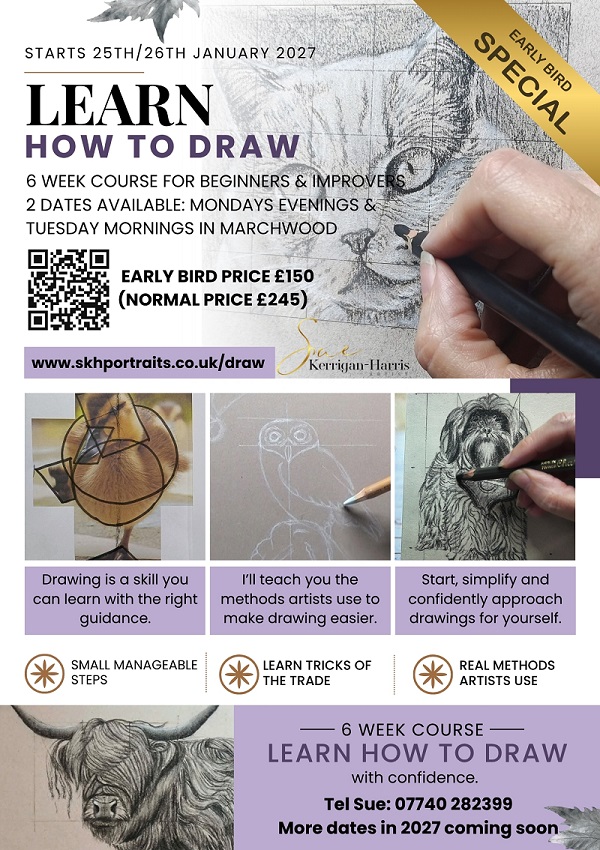
That’s exactly what I teach in my six-week drawing course. Not just what to draw, but HOW to see with an artist’s eye and make drawing feel manageable.
I’d love to know…
When you’ve tried drawing, have you ever found that you can see something doesn’t look quite right, but you can’t work out how to fix it?
That’s exactly what I teach in my six-week drawing course in Southampton. Not just what to draw, but HOW to see with an artist’s eye and make drawing feel manageable. Find out more about my 6 week drawing course here.
Not Local?
I teach drawing and soft pastel skills in my Art Club online here